One of the 10 essentials that every rider should carry on every ride!
I’m a big believer that every horseman should carry a sharp, easily accessible knife when they’re around stock. The knife is not just to cut baling twine, slice bacon, or to whittle when you’re bored. It can save lives – maybe yours.

One of the 10 essentials that every rider should carry on every ride is a very important tool: a knife.
In fact, knives are known to be one of the first tools ever invented. Even though a trail ride isn’t typically a “survival” scenario, a knife is an essential tool for every rider heading into the great outdoors; whether around the field or around a wilderness.
What do you really use a knife for?
I recently asked readers of my Facebook page (www.facebook.com/TrailMeister/) to be honest and share how they usually end up using their knife on a ride or camping trip. Here’s what they had to say:
Top 4 Uses for a Knife:
- Opening packets (of food)
- Repairs
- Making a spark (with a fire steel)
- Cutting rope in case of a wreck
Other than escaping from a wreck, these are typical uses. All normal reasons why we need a knife when we’re on the trail, and they’re all valid.
But what type of knife?
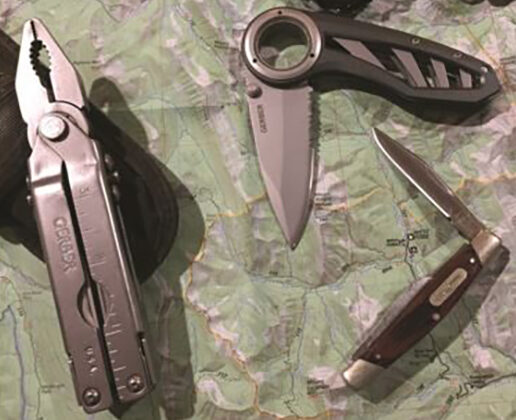
I prefer the fixed blade knife that I typically carry on my belt. In an emergency, I can pull it out, not worry about opening a blade, and quickly handle whatever situation I’m in at the time. I like the blade to be about 3.5 to 4 inches long. A blade long enough to reach the bottom of the peanut butter jar!
But there’s also a place for a folding knife. Many of the cowboys of yore carried a folding pocketknife. Called “Stockman’s Knives”, they typically had three blades. These useful tools are still available – I usually find one in my pocket. You may not cut yourself out of a wreck with one, but for opening a bag of potato chips they’re perfect!
For quick repairs, a multi-tool calls my saddlebags home. One of the biggest pros of the multi-tool is undoubtedly the pliers. The pliers are the focal point in the design of the entire tool. The pliers are the tool most folks wind up needing a lot more than they think they will, and being able to carry them with you is a huge bonus.
Fixed Blade Benefits:
- Simple to use.
- No moving parts.
- Less opportunity to cut yourself. (Since there is no need to disengage a locking mechanism and fold the blade, there is less opportunity to accidentally cut yourself in the process).
- Easier to maintain.
Folding Knife Benefits:
- No sheath required.
- Stores safely and compactly.
- Multi-use… If it’s a multi-tool, you’ll have additional gadgets beside the blade itself in one compact package.
Serrated or not?:
Many ropes today are made of nylon or polypropylene, both difficult to cut with an ordinary or plain blade. The serrated blade, or a partially serrated blade has come to the rescue and is popular with many people. In general, the serrated edge works better for slicing cuts, especially through hard or tough surfaces, where the serrations tend to grab and cut the surface easily.
Plain Blades:
In general, a plain edge is best when doing push cuts. The plain edge is also superior when control, accuracy, and clean cuts are necessary.
Push cuts:
The main cutting occurs by pushing the edge through the thing-to-be-cut. For example, when shaving, you push the edge of the knife through your beard. When peeling an apple, you push the edge under the skin of the apple. When cutting wood, you try to push the edge into and through the wood.
Slicing cuts:
The cutting action occurs while dragging the edge across the thing-to-be-cut. When slicing a tomato, you drag the edge across the tomato as you cut through it. Slicing and sawing are examples of slicing cuts.
Well there you go; my thoughts on knives. The knife is the most basic tool, and I feel naked when caught without one! I can cut baling twine, lash ropes, build a fire, plus a million other uses. Heck, I even use my knife as a screwdriver at times. I urge you to find, and carry, a knife whenever you’re around horses and mules. You’ll wonder how you ever got around without one!

As always for more information on trail riding and camping with horses visit www.TrailMeister.com. It’s the largest guide to horse trails and camps in the world and is full of tips and tricks for trail riders.