By: Pat McKNight
Training the hobby horse
In the past Training The Hobby Horse columns we discussed how horse owners are their horses’ primary teachers. Noting that trainers educate their horses whenever they come in contact with their equine “students”, or trainees.
Past columns have also discussed using 15 minute sessions in training horses. Those short training sessions can reinforce as well as advance a horse’s education. As previously mentioned, 15 minute training sessions can be strung together to form longer training periods as the way to reinforce past schooling, then working on lessons to advance the horse’s training.
But, we should take time to discuss the form those lessons should take. To begin, we need to be aware of how horses learn. When I was a college student, I took a course in child development. Going into the class, I thought I knew about kids because I helped raise eight younger siblings and had been a child care provider/babysitter for several neighborhood families. However, the college course was an eye opener! The readings and lectures helped me become more conscious of what I had absorbed through my earlier child care experiences.
But horses aren’t human; they don’t learn through lectures and readings; instructing them generally entails “body English” and body-to-body contact, i.e. hands holding a lead rope or reins and legs and seat in the saddle. The trainer must use a different approach to educating a horse.
In the educational development of horses, there are three phases; they are exposure, repetition, and progression.
Exposure, the first phase, introduces the horse to new things – new ways of communicating, new equipment, and new environments.
Gradually expose horses to halters, lead ropes, bridles, saddles, and other tack, as well as to new environments, other animals, machinery, activities, and places in a nonthreatening manner. Introduce them to cues and various maneuvers the rider wants the horse to perform.
After the initial exposure to the object or situation, the next step in the horse’s formation is repeated exposure to the stimuli. Repetition is the process of making the activity familiar to the horse. Activities such as leading, bridling, saddling, mounting, trail riding, maneuvers become familiar to the horse through repeated application.
As an example, one of my horses became accustomed to a situation through repetition while being boarded at a friend’s place. Just before deer hunting season, her husband and friends were sighting in their hunting rifles. As I stepped out of my vehicle, one of the men fired a round. I jumped at the unexpected loud noise. After identifying the sound, I looked at the horses standing in a nearby paddock. They were standing quietly, unperturbed by the loud noise. I realized they had heard it numerous times before.
When a horse has accepted the new stimulus or maneuver through repetition, training should then progress through a step-by-step process.
If you have ever encountered a situation where you asked your horse to perform a maneuver, but it didn’t seem to understand what is expected of it, it’s likely it missed a step in its schooling.
An example of missed steps in advancing training occurred during a jumping clinic I once audited. At the beginning of the clinic, the young clinician worked her students through maneuvers on the flat. As part of the ground work, the riders were trotting over a single ground pole she had laid on the ground. After the horses and riders seemed to be performing adequately in the flat work, the instructor directed the students to ride over a series of four ground poles set up in front of a jump. The horses refused to trot over the series of ground poles.
The horses refused because the clinician failed to follow the progression of introducing them to trotting over more than one ground pole. She had not introduced the horses to trot over two ground poles and then three poles before tackling four poles.
In such situations, the horse is telling the trainer it doesn’t understand how to handle the maneuver or what is expected of it. It is up to the trainer to take a step back in the lesson and start again with introduction and repetition before progressing.
There are times, despite the trainer’s best efforts to work with a horse in a step by step progression, when the horse just doesn’t seem to comprehend what the trainer wants it to do. It might seem to regress in its training or has developed amnesia.
Those anomalies in a horse’s education will be covered in the next Training the Hobby Horse column.
Pat McKnight’s Bio
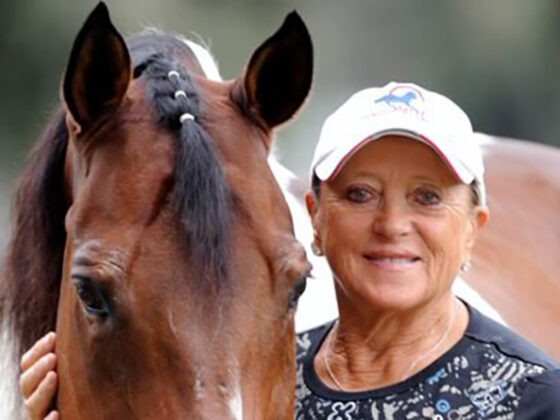
Through her horse training and rider instruction business, Equest-ETS, Pat McKnight travels to work with horse owners at their stables. As an itinerant trainer, she helps horse owners develop a training program suited for their abilities and situations.
Email- [email protected] Website-EQUESTETS.WORDPRESS.COM