“Feeding is among the most common and complicated issues horse owners face,” says Krishona Martinson, University of Minnesota Extension equine specialist. “We’ve seen a doubling in hay costs in the last several years, at a time when many horse owners have felt the pinch of the economy.”
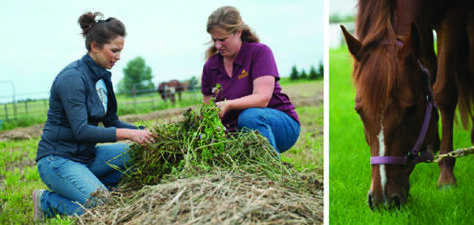
Extension’s research yields valuable answers about the most efficient way to feed horses, especially when droughts and flooding make hay scarce and expensive. For example, horses waste a lot of hay, but the type of hay feeder makes a big difference. Using a round-bale feeder resulted in as little as 6 percent hay waste, whereas not using a feeder resulted in up to 57 percent waste.
In 2011, Extension’s equine program received a Morris Animal Foundation grant to research unwanted horse trends. They shared their results with the horse community, law enforcement and advocacy groups early in 2014. “The research identified areas of need for education,” Martinson says. “This was done partly by mapping where horses were being resold more frequently.
“We educate people on what it costs to keep a horse when horses are healthy and when problems arise,” says Martinson, who also conducts research into factors that lead to horse neglect and abandonment. According to her findings, when horses are not well cared for, their circumstances are most often linked to the cost of horse ownership, followed by the owner’s knowledge, and the owner’s physical and mental health.
The price of neglect
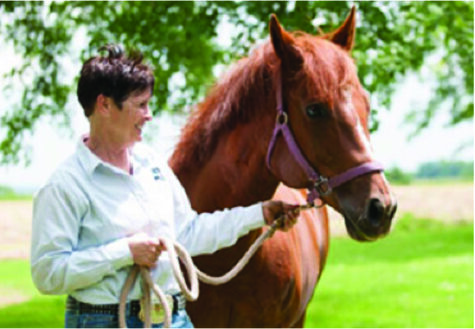
Costs quickly accumulate at This Old Horse, a nonprofit organization that provides lifelong sanctuary to horses. Nancy Turner, president, relies on Extension research to help her sanctuary operate efficiently. Pictured with Fiona, a rehabilitated horse.
Since 2007, there has been a 400-percent increase in the number of unwanted horses in Minnesota, burdening both the public and nonprofit sectors.
Kanabec County Assistant Attorney Reese Frederickson, a veteran of horse neglect prosecutions, knows the neglect problem well. “The suffering is born by the animals, but the public pays the cost,” Frederickson says.
When emaciated, ill or otherwise mistreated horses are seized from their owners, he explains, counties are legally responsible for seven to 10 days of their care. Besides feed and boarding, neglected animals typically require substantial veterinary attention. One case Frederickson recalls resulted in a $20,000 cost to Kanabec County.
One way to keep costs down for the public is to work with the nonprofit community dedicated to caring for rescued and rehabilitated horses. Extension’s equine program works closely with these programs to help them maximize their ability to step in and nurture horses back to health.
“We’ve reached the point of being maxed out a lot over recent years,” says Nancy Turner, president of This Old Horse, a sanctuary for retired, rescued and rehabilitated horses in Dakota County. “I turn to Extension for the research on how we can better manage our sanctuary, and for the educational resources to train the volunteers I depend on in order to keep going.” Frederickson welcomes Extension’s work to build awareness of the costs associated with horse ownership. “Prevention is important,” he says. “If people know up front what a horse can cost, we can save the public from the financial burden so county law enforcement and courts can direct resources elsewhere.”
Apps make horse care easier
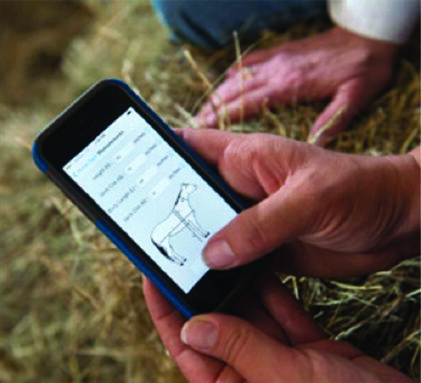
Minnesota horse owners are enthusiastic participants in Extension field days and regional horse owner programs, but they’re also tech-savvy. Krishona Martinson, equine specialist and program leader, says, “They’re into social media, smart phones and video. And so are we.”
In 2013, Extension released two applications for mobile devices. “Hay Price Calculator” and “Healthy Horse” help horse owners make cost and health decisions for their animals. They are the first apps offered for sale by the University of Minnesota. By summer’s end, the equine program had sold more than 1,500 apps. It’s just one of the ways Extension engages with participants to make sure they have access to research on the go and around the clock.