Equine Monthly
  • Home
  • ARTICLES
    • Bedding
    • Deworming
    • Dr. Tom Schell, DVM, CVCH, CHN
    • Dressage
    • Education
    • Equine Art
    • Equine Careers
    • Equine Health
    • Equine Organizations
    • Equine Stories
    • Equipment
    • Events
    • Feed
    • Julie Christie
    • Legislation
    • Lynn Palm Equestrian
    • Racing
    • Showing
    • Showjumping
    • Tack
    • Training
    • Travel
    • Uncategorized
    • Youth
  • Events
    • Trail Guide
      • Illinois Trails
      • Iowa Trails
      • Minnesota Trails
      • Nebraska Trails
      • North Dakota Trails
      • South Dakota Trails
      • Wisconsin Trails
    • Expos and Fairs
    • Horse Shows and Clinics
  • ADVERTISE
    • Digital/Web Ads
    • Print Ads
  • CONTACT
Equine Monthly
Equine Monthly
  • Home
  • ARTICLES
    • Bedding
    • Deworming
    • Dr. Tom Schell, DVM, CVCH, CHN
    • Dressage
    • Education
    • Equine Art
    • Equine Careers
    • Equine Health
    • Equine Organizations
    • Equine Stories
    • Equipment
    • Events
    • Feed
    • Julie Christie
    • Legislation
    • Lynn Palm Equestrian
    • Racing
    • Showing
    • Showjumping
    • Tack
    • Training
    • Travel
    • Uncategorized
    • Youth
  • Events
    • Trail Guide
      • Illinois Trails
      • Iowa Trails
      • Minnesota Trails
      • Nebraska Trails
      • North Dakota Trails
      • South Dakota Trails
      • Wisconsin Trails
    • Expos and Fairs
    • Horse Shows and Clinics
  • ADVERTISE
    • Digital/Web Ads
    • Print Ads
  • CONTACT
Home ARTICLES Switching to Hay?
  • Feed
  • Uncategorized

Switching to Hay?

  • March 9, 2025
  • Chris Grambort
Total
0
Shares
0
0
0

Remember Vitamin E

As the growing season winds down in autumn, horse owners in many climates must provide horses with an appropriate alternative forage to fulfill fiber requirements. In most cases, this involves the use of hay, though other products such as haylage or hay cubes are appropriate and sometimes fed.

The question that looms large for most owners is when to offer alternative forage. The pasture reveals a couple of important clues, namely growth rate and plant health.

Owners will know when pasture growth slows as there will be less need for routine mowing and maintenance. Depending on stocking rate—that is, the number of horses on any given acreage—pasture might withstand a slowdown in growth rate and continued grazing, so long as more land is allotted per horse. A large, seven-acre paddock that comfortably sustained five horses in peak growing season might support three as pasture growth declines.

Observation of grazing behavior might be a tipoff, too. If horses spend more time grazing, they are likely finding less to eat. In periods of lush growth, horses may rest more often, as it is easier for them to satisfy their appetites and their need to graze. Plant health is a more obvious indicator. As autumn segues into winter, pasture grasses often turn brown and unpalatable, at which time growth is almost assuredly arrested. Horses will snack on these remnants, but more nutritious forage should be offered.

Owners ought to offer hay as soon as they feel horses are not consuming sufficient pasture to meet daily forage requirement, which is about 1.5-2% of body weight daily. For a 15.2-hand, 1,100-lb horse, that would be 16.5-22 lbs. of hay each day. Keep in mind, though, that this amount will likely satisfy the horse’s complete forage requirement.

If the horse is still nibbling away at pasture much of the day, it might need only a portion of this. If the horse leaves hay in favor of pasture, then too much hay is probably being fed at the time. Requirements can be gauged through consumption.

One vitamin that is particularly deficient in diets composed of preserved forages such as hay is vitamin E, an important antioxidant in the horse’s immune arsenal. The most effective source of supplemental vitamin E is d-alpha-tocopherol or natural vitamin E. Nano•E is a natural-source vitamin E supplement that possesses a unique delivery action, nanodispersion, which allows the vitamin to hit target tissues more quickly than other vitamin E supplements. Nano•E is available worldwide.


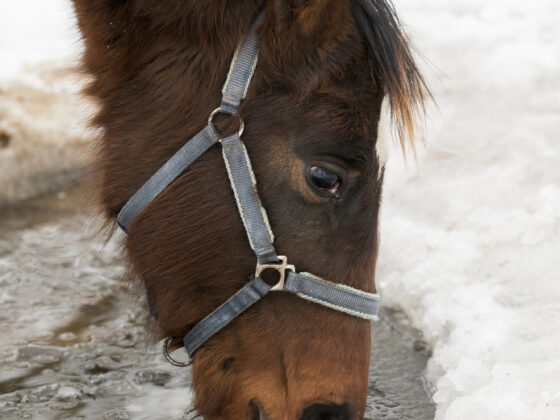
Photo Credit: Brittany Bevis

Total
0
Shares
Share 0
Tweet 0
Pin it 0
Chris Grambort

Previous Article
  • Equine Health
  • Feed

Maintain Your Horse’s Gut – Keep Them Hydrated During Summer Months To Maintain Health And Energy

  • March 5, 2025
  • Larry Grambort
View Post
Next Article
  • Equine Health
  • Equine Organizations

Avoiding A Lameness Exam

  • March 10, 2025
  • Larry Grambort
View Post
You May Also Like
View Post
  • Uncategorized

Finding Your Purpose By: Sharlyn Fellenz

  • rmj
  • December 26, 2025
View Post
  • Equine Health
  • Feed

Maintain Your Horse’s Gut – Keep Them Hydrated During Summer Months To Maintain Health And Energy

  • Larry Grambort
  • March 5, 2025
View Post
  • Equine Health
  • Feed

What Is “Vegetable” Oil?

  • Larry Grambort
  • March 4, 2025
View Post
  • Equine Health
  • Feed

Add A Serving Of Caution To The Tender Spring Grass

  • Larry Grambort
  • March 3, 2025
View Post
  • Feed

Beyond the Pasture Fence

  • Chris Grambort
  • March 2, 2025
View Post
  • Equine Health
  • Uncategorized

Biomechanics Of Arena Footing

  • Chris Grambort
  • March 2, 2025
View Post
  • Equine Health
  • Feed

Maple Trees Wreak Havoc On Horses

  • rmj
  • March 15, 2021
View Post
  • Equine Health
  • Feed

Feeding In Winter

  • rmj
  • January 15, 2021
Follow Us
Facebook
Trending Posts
  • 1
    Managing COPD & Allergies In The Horse With A Herbal Blend
    • January 15, 2021
  • 2
    Scratches, Rain Rot & Skin Allergies
    • October 17, 2020
  • 3
    Rebuilding Your Horse’s Core For Health And Soundness
    • October 16, 2020
  • 4
    Rebuilding The Horse’s Hoof For Soundness & Health
    • March 15, 2021
  • 5
    Horse Anxiety And Adaptogens
    • June 17, 2020

CLICK HERE FOR NATIONAL TRAIL GUIDE

About

Equine Monthly LLC PO Box 217. Osseo, WI 54758

Social:
  • https://www.facebook.com/equine.monthly

Phone: 817-307-5944

@2026 Equine Monthly. All Rights Reserved

Input your search keywords and press Enter.