By: Lynn Palm
In a previous article I stressed the importance of location when conducting ground training lessons with any horse. If you follow the progression I gave you to introduce each new ground training lesson, you will be giving your horse the best opportunity to learn. If your horse demonstrates it does not understand, or is not responsive at any point in this progression, go back to the previous location to repeat the lesson until there is improvement.
Before starting any lessons, you must have the right equipment to safely and properly teach groundwork. You will need a halter, longe line, and an “in-hand” whip. I also recommend putting leg protection, such as splint boots or polo wraps on your horse for all lessons. I also suggest bell boots for horses that might be uncoordinated, have hoof problems, or a tendency to over reach with their stride.
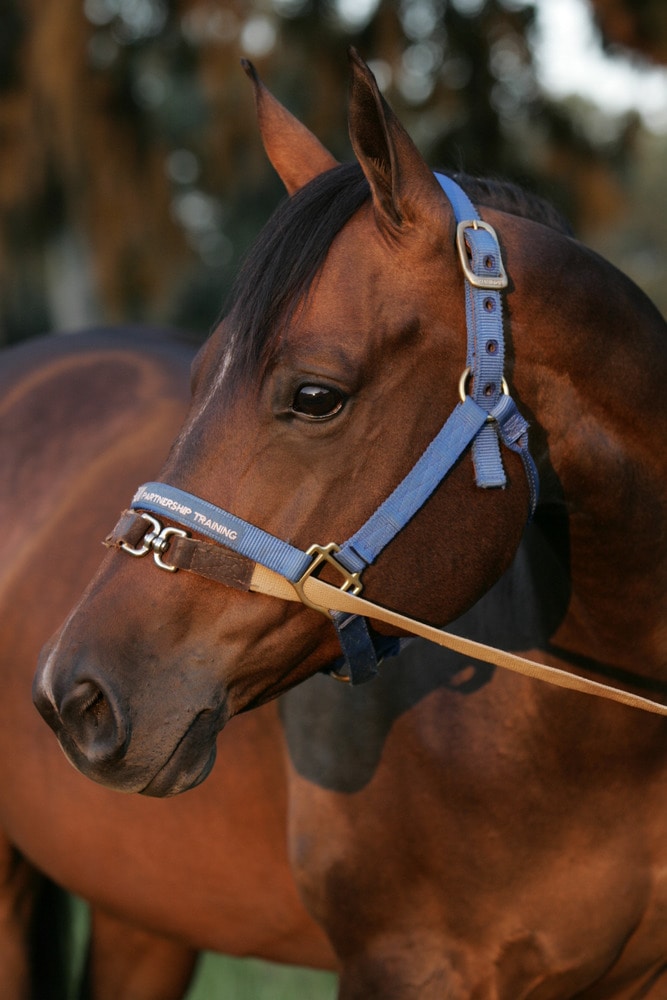
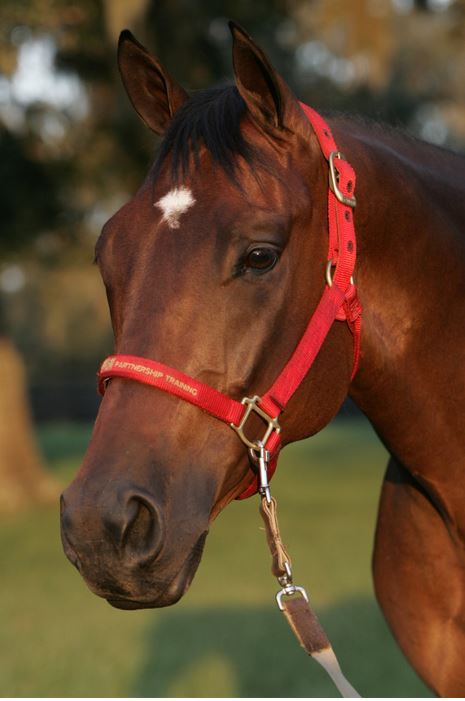
The halter must fit snug, not tight. The nosepiece should lie 1-inch down from the bottom of your horse’s cheekbone. I like a nylon halter for training. I have specially designed my new Palm Partnership Training Halter with side rings large enough so a longe line will pass through them. This is also one halter that adjusts to fit 2-year old horses to medium and extra large size mature horses!
I prefer to use a longe line and only use a lead when handling a horse for daily routine leading, unless the horse still needs training. I will use a longe line until my horse is fully trained and consistently responsive to my commands.
I use a flat, woven cotton longe line. It is easier to grip and keep organized than a round longe line. The longe line may end either in snap or a length of chain called a “stud chain”. Stay away from using a nylon longe line because it can cause a serious rope burn if the line slips through your hand. Nylon is also very slippery and difficult to keep organized.
Taking Riding Lessons – for me!
I was excited to have the opportunity to take riding lessons from Jane Savoie. Jane is an Olympic/International Dressage rider and competitor. Besides being an outstanding genuine person who has compassion for horse and rider, I consider Jane one of the best, if not the best, equestrian educators in the world. Several years ago, I was honored when Jane asked me to write the “forward” to her book Cross Train Your Horse-Book One. Simple Dressage for Every Horse, Every Sport.
What struck me about Jane is how she stresses going back to the basics. Even though I was working to improve more advanced lateral work (shoulder in, haunches in, half-pass), flying lead changes, and tempi flying lead changes, Jane reinforced that a rider must keep perfecting the basics to advance the strength, training, and conditioning of the horse.
Jane’s evaluation of my horse indicated that I still needed to perfect straightness. As Jane defines in Cross Train Your Horse, straightness is: “Developing the horse’s ability to keep its body straight while traveling straight or bend its body along the arc of curves with its spine overlapping the line of travel and its hind feet stepping into the tracks of the front feet.”
She also found that I needed to create more forwardness in my horse. Forwardness is the responsiveness of the horse to move forward with energetic strides. This was another key factor in improving my horse’s lateral work and tempi flying lead changes. I had improvements in the lessons, but the many exercises she gave me will take months and years to master. I am excited with these challenges.
Jane’s philosophies and teaching techniques are very similar to my own. “Going back to the basics” is one of the foundations of my Palm Partnership Training programs. Our e-mail newsletters are available to help you improve ground training basics to build your skills as a horsemen and rider… and a stronger partnership with your horse.
Your Next Step…
Go back to the basics with your ground training. Your next step in advancing your ground training skills is to practice keeping your longe line organized by making loops in it at least 12 inches long or coiled in a figure “8” in your outside hand. I see too many handlers with their longe line either dangerously coiled in their hands or dragging and getting tangled in their legs. I am asking you– please learn how to coil your longe line properly! Practice so that you can organize your longe line without looking at it. In my future articles I’ll give you suggestions on how to use the halter, longe and an in-hand whip as ground training tools.
Until then, follow your dreams!
Ground training is an important part of all of my schools. Visit www.LynnPalm.com and click on “Clinics.”
For more information or to schedule your own event, please call 1-352/629-3310