By: Lynn Palm
Developing your horse into a safe, willing partner for years to come starts with ground training. Often the problems I see riders having with their horses can be solved with ground training.
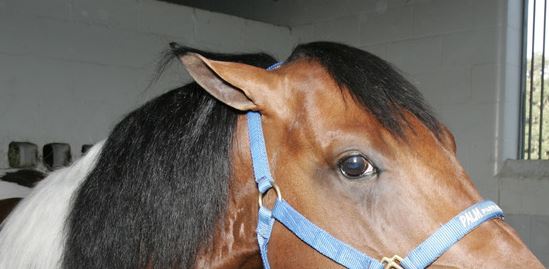
Where you conduct ground training lessons is critical to giving your horse the best chance to learn. Distractions can take away from a horse’s ability to respond to the handler’s commands. Your horse will be better able to concentrate in a smaller area, rather than in a larger space. Select a location where it will be able to retain and learn the lesson you are teaching, without the distractions of the outside environment. Once it is familiar with the lesson, you can graduate to a larger work area. When teaching a new maneuver, always practice it at the same location until your horse responds very well and then move on to other areas.
I recommend following these steps of progression when ground training any horse. Begin ground training lessons in the horse’s stall where the location is familiar and there is the least amount of distractions. When your horse demonstrates that it has learned the ground training lesson in the stall, move on and repeat the lesson in a slightly less secure location. The isle of a barn makes a great next step. Once your horse is responsive in the barn aisle, graduate to a slightly less secure place, like a round pen or paddock. Continue this progression to less secure environments moving to an indoor arena, to an outdoor arena, finally asking for the maneuver on the trails or other off-site locations.
Follow this progression as you introduce each new ground training lesson to give your horse the best opportunity to learn, while keeping distractions to a minimum. If your horse appears to not understand or is not responsive, go back to a more secure location to repeat the lesson until there is improvement. For the horse, continuing this learning process at each new location is like learning the lesson again – so be patient to build a great partnership with your horse.
Helping Each Other Improve…
I worked with a group of four women who were interested in learning through Palm Partnership Training. They had very different riding interests. Three of the riders rode competitively as novice, amateur riders. The competitive riders had just finished successful show seasons and won many end of the year championships. The fourth member of the group was a commercial airline pilot! She enjoyed riding recreationally. Everyone in the group rode both Western and English.
What I found most interesting was how the competitive riders and the recreational rider helped each other improve. Even though the recreational rider was mounted on a horse she’d never ridden before, her job skills gave her determination, focus, and confidence. I challenged her with different obstacles and courses unfamiliar to her, but well known to the competitive riders who were mounted on their own horses. The recreational rider did a better job of successfully controlling her horse and completing the maneuvers than the competitive riders.
The recreational rider demonstrated that the very skills that made her a good airline pilot were important for having good control of her horse. In turn, she learned from the competitive riders that the challenge of showing can be a rewarding, exciting experience that she might someday enjoy. The competitive riders learned to control their horses better and had to improve their “pilot” skills!
The group’s instruction included in-hand work. The competitive riders learned how to use ground training to perfect the maneuvers required for showmanship events with greater coordination. The recreational rider found ground training a great way to help her work better with her horse and improve her hand-eye coordination from the ground with more correctness.
The students’ experiences reminded me of the importance of ground training. Ground training and showmanship can become an “art”. It can take years of practice to perfect. It’s well worth the time for the benefit it brings in building a harmonious relationship with a horse and improving the handler’s training and riding skills. All my long-term riders master showmanship and in-hand training skills.
Your Next Step…
Whether you are starting a young horse, re-schooling an older mount, or needing to improve your eye for understanding your horse…ground training will improve a horse’s responsiveness to commands and build your skills as a handler and rider.

Ground training will bring out the best in your horse. There is no better reward than your horse respecting and trusting you. It is also the greatest foundation that you can give your horse for a very successful future under saddle!
Ground training is an important part of all of my schools. Visit www.LynnPalm.com and click on “Clinics.” For more information or to schedule your own event, please call 1-352/629-3310.