By: Zoie Matthew
“A Spate of Horse Deaths at Santa Anita Has Activists and Lawmakers Pushing for National Reform. A crackdown on doping is in the works.”
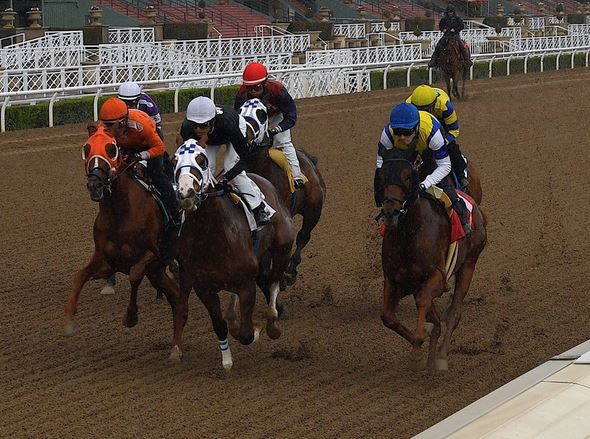
Animal rights activists have criticized the United States horse racing industry for its high fatality rates for many years. According to the Jockey Club’s Equine Injury Database, an average of ten horses a week have died at American racetracks in 2018. Over the past year, Arcadia’s Santa Anita Park has been in the spotlight as its death toll spiked, with 33 horses dying at the facility since December.
While some of these deaths have been attributed to inclement weather and a dirt track, many also blame a reported tolerance for trainers who have been cited for giving animals performance-enhancing drugs, which experts say are a leading cause of horse death. Now, in the wake of national media attention surrounding the deaths, a number of animal rights groups and industry leaders are pushing to establish a national program that would crack down on the use of these drugs, bringing the United States in line with international standards.
Drugs like Lasix, a diuretic, causing horses to shed water weight, can weaken the animals’ bones over time, leading to a greater likelihood of injury, says Marty Irby, executive director of Animal Wellness Action. “Then they begin administering other drugs, like pain-masking and numbing agents when they’re injured, then running them when they shouldn’t be,” he says. Typically, unable to recover from the bone injuries they incur, the horses are euthanized.
Introduced in March, the Horse Racing Integrity Act would ban the use of these drugs on race day, and would create an independent committee to oversee testing and enforcement nationwide. Made up of horse racing experts and members of the U.S. Anti-Doping Agency, which monitors human athletes’ drug testing, the committee would establish uniform standards for racetracks, now overseen by 38 different jurisdictions.
Thus far, the bill has been co-sponsored by 172 members of Congress, plus garnering support from numerous animal rights groups. Two legs of the triple crown – the Belmont Stakes and the Preakness Stakes – are proponents of the bill. Churchill Downs, which owns the Kentucky Derby, remains neutral.
The Stronach Group, owners of The Preakness Stakes, has also owned Santa Anita for 20 years. In March, it implemented a new set of strict regulations at Santa Anita, banning both race-day drugs and whips, but denied the California Horse Racing Board’s request to cancel its season in June.
Currently, the Los Angeles district attorney’s office is conducting a sweeping investigation into this year’s spate of horse deaths.
California Horse Racing Board rejects Bolt d’Oro trainer’s requests for hearing on Justify’s failed drug test
Mick Ruis is asking for answers. He is seeking a hearing from the California Horse Racing Board (CHRB) to revisit the race that launched Justify toward a Triple Crown and the disregarded drug test that has tainted that achievement. His request was rejected.
“Please be advised that the Board dismissed the matter as authorized under (California) Business and Professions Code 19577(d),” CHRB counsel John McDonough wrote in reply to a letter from Ruis’ attorney, Darrell Vienna. “Therefore, further hearing on the subject is not required or warranted.” These are probably not the last words on that subject.
“The request for a hearing is necessary to exhaust administrative remedies prior to litigation,” Vienna said via e-mail Tuesday night. “However, at this point, we are hopeful that the CHRB will provide a full, open and transparent hearing. Should the CHRB fail to provide such a hearing, we do not rule out the pursuit of any and all legal remedies.” “We don’t want to make a big scene out of this,” Ruis said. “But we want to get to the bottom of it.”
The owner/trainer of Bolt d’Oro wants to press the CHRB on its decision against disqualifying Justify from the Santa Anita Derby despite a failed drug test; a race that enabled the lightly raced colt to qualify for the Kentucky Derby and cost Ruis $400,000 in purse money.
Substantial traces of the banned substance scopolamine were found in Justify’s urine following his three-length victory over Ruis’ Bolt d’Oro at Santa Anita. But the results of that test and the process by which regulators gave Bob Baffert’s horse a pass were not shared publicly until the New York Times broke the story.
Though the CHRB’s position has been that Justify’s positive test was the result of an “environmental contaminant” rather than chemical chicanery, Ruis questions whether the board abused its discretion in a case fraught with conflicts of interest and seeming double standards.
At the time the CHRB began its deliberations, Baffert was training a horse for the board’s then-chairman, Chuck Winner. Meanwhile, California had yet to adopt standards revised by the Association of Racing Commissioners International downgrading scopolamine from a Class 3b substance – one that could have triggered disqualification – to a less serious level 4c. Originally Triple Crown winner Justify reportedly failed a drug test weeks before the Kentucky Derby.
News of Justify’s drug test and the CHRB’s failure to get ahead of the story has proved to be a royal pain to the sport of kings; another argument for national oversight of racing and another blow to a business reeling from a rash of fatalities at Santa Anita.
“Denial of further investigation into the potential corruption in California continues to drag down the industry and compromise the welfare of the horses,” Animal Wellness Action executive director Marty Irby said in response to the CHRB’s stance. “Congress should intervene.”
Horses commonly ingest scopolamine when jimson weed infiltrates their feed, and multiple veterinarians have expressed doubt about its benefits. Dr. Mary Scollay, executive director of the Racing Medication and Testing Consortium, suspects the substance may be more “performance-impeding than performance-enhancing.” “It’s not clear why anyone would administer that in hopes of getting an advantage,” she said.
Still, inasmuch as winning the Santa Anita Derby was worth $600,000 and second place paid only $200,000, Ruis has a hefty financial incentive to overturn the CHRB’s decision. And he’s not the only potential plaintiff. Hall of Fame trainer Jerry Hollendorfer, who is battling a ban from multiple California tracks, saddled fourth-place finisher Instilled Regard in the Santa Anita Derby.
Had Justify been promptly disqualified – implausible given the turnaround time for drug testing and CHRB procedures – third-place finisher Core Beliefs would have had enough points to qualify for the Kentucky Derby.
“A rule’s a rule,” Ruis said. “It was a banned substance. It was an overage. That’s it: disqualification. You don’t get to appeal, “Oh it was jimson weed.” You know what? Everybody on the backside can make an excuse for something, right? But not everybody has money to hire an attorney so they can continue to race.”
Ruis, who purchased the Woodford Throughbreds farm near Lexington in the spring, has the means to pursue the matter and is motivated by the belief Justify’s drug test was “swept under the rug.”
“I’d rather fight than go and argue in a court,” he said. “It’s ridiculous to hire an attorney. To hire attorneys is the last thing Mick Ruis ever does. I think it’s a waste of money. But I had so many people on the backside who said, ‘Mick, we’ve got to stop this. This is ridiculous.’ I mean, very, very credible horsemen.
“I could care less about the $400,000. That’s not it. But I do care for every small trainer and little guy who is running and racing clean on the backside to have a chance. Let the best horse win, not the best whatever-else-they-use win.”
Vienna said the request for a hearing is “based upon evidence that members of the CHRB were not apprised of significant and essential facts and were misinformed regarding existing rules and regulations.” He declined to elaborate.
“I would hope the CHRB would do the right thing,” Ruis said. “But then again, if they don’t and we go farther, I would sure love to start subpoenaing records and stuff like that. Then we can really find out what went on.