By: Sheri Pederson
If you have a horse that you no longer ride but still want to play with, or if you want to increase your bond with your horse, or increase your confidence in one another or are just looking for something different and fun to do, try Horse Agility!
Horse Agility is based on Dog Agility and was founded in 2009 by Vanessa Bee in the UK. Vanessa had incorporated obstacles and horsemanship into her lessons and training for years, but realized no one had standardized it for competition, and so it began. Horse Agility is done with both horse and handler on the ground, navigating a series of obstacles and demonstrating clear communication and positive horsemanship. It can be done just for the fun of it, or competitively.
Horse Agility can strengthen the communication and connection between you and your horse, as well as help your horse learn to think rather than react. Humans learn to better understand their horse and how to break down challenges into small achievable tasks for their horses. Horses learn to be confident that their humans won’t over face them or put them in harm’s way, and hopefully will see their people as “the coolest person at the party” and WANT to play with you.
In competition, there are 10 obstacles in a course, each worth 10 points – 5 for the handler and 5 for the horse. The handler loses points for having a tight lead rope or presenting the obstacle to the horse poorly or using force to complete the obstacle. The horse loses points for trying to evade if the obstacle was presented fairly, not completing the task, ‘disconnecting’ from the handler, etc. No whips/sticks may be used in competition – just a horse, halter and lead rope. There is a Liberty division for those wanting to try their skills without even the halter and lead rope!
There are different levels of competition and while the obstacles usually are pretty much the same for each level, the requirements differ, reflecting the more advanced communication skills needed at the upper levels. Pretty much anyone with a horse that can be politely led and isn’t hugely spooky can compete at Starter Level. Next is First, then Medium, Advanced and Advanced*. Liberty has 3 levels: Bronze, Silver and Gold.
To get started at home, you could start with focusing on your leading skills. Does your horse ‘read’ your body and stay with you while you walk and turn corners or do you need to tug the rope occasionally to keep him/her with you? If you take bigger or smaller steps, does your horse mirror that? This sounds SO simple, yet there are so many people that can be seen dragging or being dragged around by their horses! This is something you can work on every time you bring your horse in or out! The handler should be between the horse’s head and shoulder. Do you need to encourage your horse to walk up by you or to quit getting out in front of you?
“Easy peasy”, you say, “My horse leads like a dream!” Cool! Move on to standing still! Can you ask your horse to ‘stand’ or ‘wait’ and walk away from it for 3 seconds? 5 seconds? Start by just staying with your horse, but if moves any feet after you say ‘wait’, move them back. Before they move again, say ‘good wait’ and move off. Build this by stepping away from the horse, a little at a time, during the ‘wait’. If you have a major fidgeter, you may spend quite a while convincing the horse that you really expect the feet to STAY PUT. Starter level is stepping 10 ft way for 3 seconds and coming right back. Advanced* is going 10 ft away and walking a circle around the horse back to its head, then going out again the other direction. Again, simple, but not necessarily EASY.
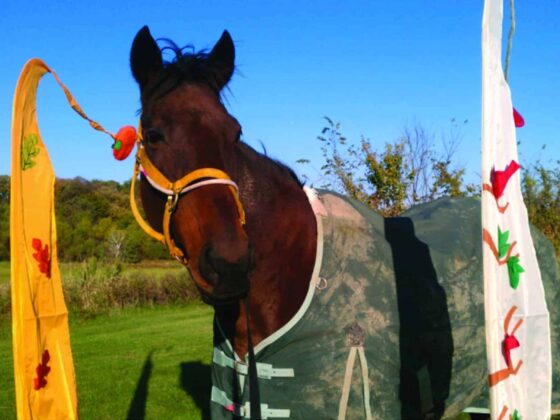
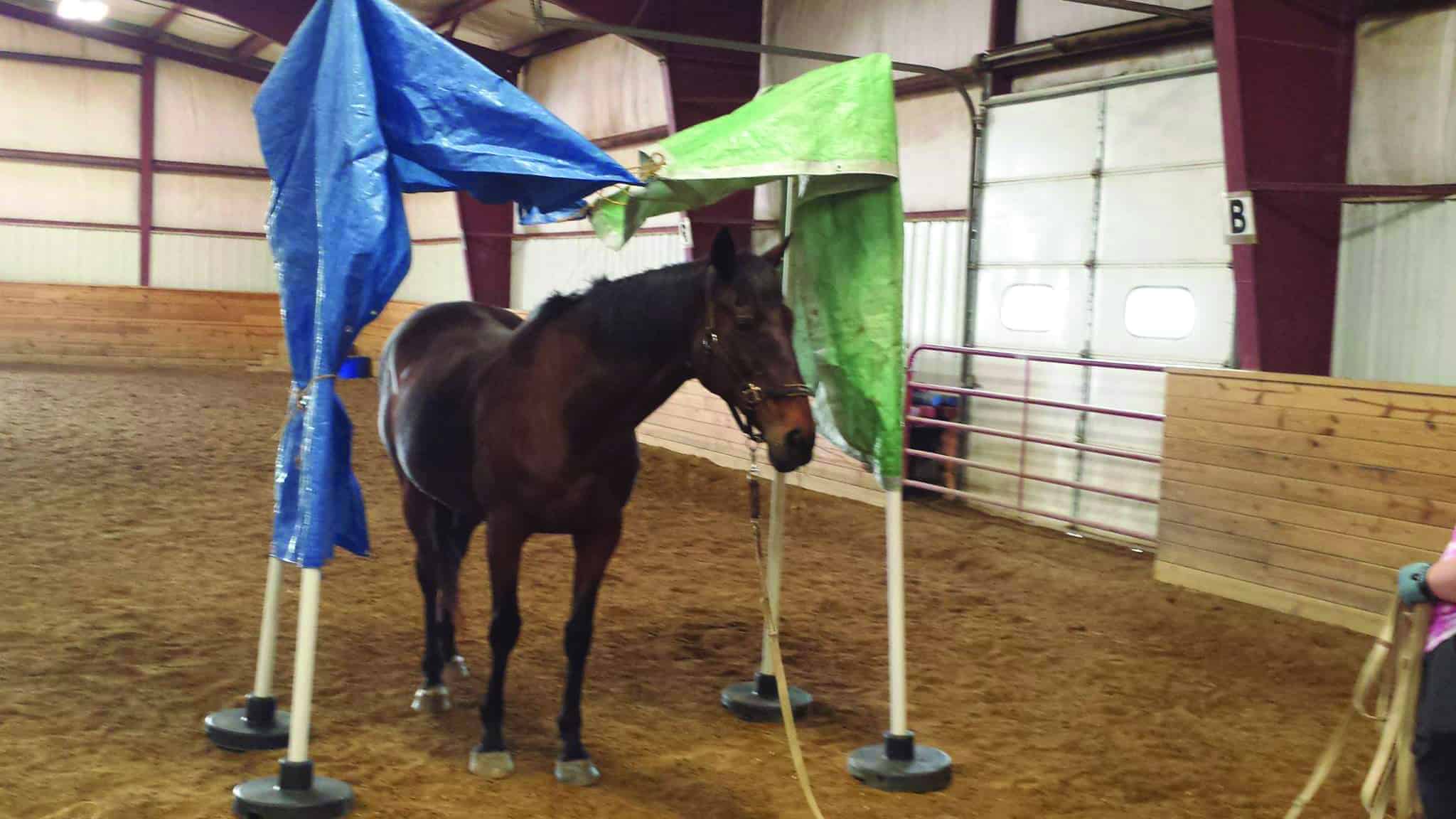
Typical obstacles include going over or standing on a tarp, going thru a ‘curtain’, weaving 5 cones, going thru a ‘scary corner’ (an “L” with flagging or scary objects on either side that are NOT dangerous if the horse spooks in the middle), going thru a labyrinth, waving or carrying a flag, going thru a ‘narrow gap’ (3’3” – 4’, depending on the level of the horse, backing 2 feet or 4 feet over a ground pole….you can create so many challenges that are SAFE and still interesting with stuff all around you. Many of the obstacles are great desensitizing opportunities and others present good lead-ins for other training. For example, leading the horse on a 3’ wide tarp (horse not to step off), then asking the horse to walk thru a narrow gap is a great start for trailer training! The ‘narrow gap’ might start out as 2 cones, then progress to 2 jump standards, then 2 barrels, then 2 sets of standards or blocks with poles to make a ‘hallway’, then you could put blankets or coolers over the poles to make the sides look solid….you get the idea, hopefully! “Chunk it down!” – make each learning step bite-sized and fun and your horse will be happy to keep playing with you!
About Sheri Pederson
I’ve been involved in Horse Agility for two years now and compete internationally via the OnLine Horse Agility (OLHA) League. My mare and I have moved from Starter to Medium and I’m always amazed at her willingness and curiosity. She has overcome so much fear and now approaches new things to check them out and to try to figure out what we will do with it. Two years ago, it was “run first, think later”. We started doing Liberty in the winter of 2014 and moved to Silver in January 2015. I am proud to say that we have a great time together!
I host periodic “play days” for boarders where I keep my mare, but also had one at Jodi Ely’s last fall and would be happy to help you coordinate something at your barn if you’re interested. In July 2015, on the 18th and 19th, there will be an agility clinic at the University of MN! Please email me if interested in auditing or participating: [email protected]